
Is Your Spine the Missing Link in Athletic Recovery?
You’re putting in the miles, hitting your lifts, staying on top of nutrition—and yet your body still feels flat. Soreness lingers longer than it should. Your stride feels tight by mile two. The bar feels heavier than the numbers suggest. If that sounds familiar, you’re not alone. Here in Charlotte, we see runners, lifters, cyclists, and weekend pickleball warriors who train hard but don’t feel like they’re bouncing back. One often-overlooked piece of the recovery puzzle? Your spine and the way your body’s control system communicates during and after training.
In this article, we’ll unpack how spinal mechanics and your nervous system can influence recovery, explain where thoughtful chiropractic care may fit, and share simple ways to support your body between workouts. Our goal at Feel Good Chiropractic is to help you understand your body better—and get you back to training with confidence.
Quick definition: When we say your spine might be the missing link in recovery, we mean that stiff or irritated spinal joints and surrounding tissues can affect how muscles fire, how you move, and how your body interprets and responds to load. That can show up as tightness, slower recovery, or recurring “little” pains that stall progress.
What does it mean if training is up but recovery is down?
It often means your body is working around something, not with it. The spine is the central hub for movement control. When joints don’t move well or your posture is off under load, your nervous system can keep certain muscles “on guard,” reduce your efficiency, and limit how well you bounce back between sessions.
Table of Contents
- Why Recovery Stalls Even When You’re Training Smart
- The Spine–Nervous System Connection in Plain Language
- Common Training Patterns We See in Charlotte Athletes
- Simple Biomechanics: How Stiff Segments Change the Load
- How Chiropractic Care Fits Into Recovery
- What Care Looks Like at Feel Good Chiropractic
- Practical Ways to Support Recovery at Home
- When to See a Chiropractor for Recovery Plateaus
- Safety and Red Flags: When to Seek Medical Care Now
- Myths and Facts About Spine Care and Athletic Recovery
- A Calm, Local Closing
- FAQs
- TL;DR
Why Recovery Stalls Even When You’re Training Smart
Recovery is more than rest days and protein. It’s the sum of quality sleep, circulation, tissue health, nervous system balance, and how well your joints and muscles share the load. If any of these areas is out of sync, you may feel like you’re doing everything right without the payoff.
For many active people in Charlotte, the roadblock isn’t effort—it’s inefficiency. Inefficient movement makes each rep or mile cost more. Think of it like a wheel out of alignment on your car: you can still drive, but you’ll burn through tires faster and the ride won’t feel smooth. When spinal segments are stiff or irritated, your body often compensates somewhere else, and that compensation can drain energy and slow recovery.
The Spine–Nervous System Connection in Plain Language
Your spine protects your spinal cord and the nerve roots that branch out to every muscle group. Those nerves carry messages like “contract,” “relax,” and “stabilize.” If a joint is moving poorly, the small sensors around it can send noisy information. Your brain may respond by tightening certain muscles, limiting range of motion, or changing your movement pattern to protect the area.
That protective strategy helps in the short term, but it can become the new normal. Over time, you may notice recurring tight calves, hamstrings that never fully release, or a low back that complains after long rides on the Little Sugar Creek Greenway. Improving how spinal joints move can help restore clearer signalling, which often leads to smoother movement and better recovery.
Common Training Patterns We See in Charlotte Athletes
Across South End, Dilworth, NoDa, and beyond, a few patterns show up again and again:
- Runners: The mid-back and pelvis get stiff, stride shortens, and calves or hamstrings take on extra work. Hill runs around Freedom Park feel harder than your watch suggests.
- Lifters: The lower thoracic and upper lumbar areas don’t extend well under the bar. The body borrows motion from the low back or shoulders, and recovery from squats or overhead work lags.
- Desk-to-gym athletes: After long laptop hours, the neck and upper back feel rigid. Evening workouts hit a body that’s already bracing, so you finish more burned out than built up.
Simple Biomechanics: How Stiff Segments Change the Load
Movement is teamwork. When one area underperforms, its neighbors work overtime. Here’s a quick look at how that plays out:
| Training Issue | How the Spine Factors In | What You Might Feel |
|---|---|---|
| Shortened running stride | Stiff mid-back and hips reduce rotation and hip extension | Calf/hamstring tightness, IT band discomfort, side stitches |
| Sticking point in squats | Limited thoracic extension shifts load to low back | Low back tightness post-session, quad dominance, cranky knees |
| Overhead press discomfort | Poor ribcage mobility and scapular mechanics | Neck/shoulder tightness, trap overuse, reduced lockout smoothness |
| Post-ride low back ache | Prolonged flexed posture with limited segmental motion | Back stiffness getting off the bike, hip flexor tightness |
Improving segmental motion doesn’t replace strength or conditioning work—rather, it can help each part do its job so your training sticks.
How Chiropractic Care Fits Into Recovery
Chiropractic care is conservative, non-surgical, and drug-free. It focuses on restoring healthy joint motion, reducing irritation, and helping your body move with less resistance. For athletes and active adults, that often means easier range of motion, more efficient patterns, and less post-training tension.
Spinal manipulation and related manual therapies have been shown in research to help with certain spine-related pains and function. Guideline groups such as the American College of Physicians include spinal manipulation among recommended non-pharmacologic options for low back pain, alongside exercise and other conservative therapies. Evidence varies by condition, but for many people, chiropractic can be a useful part of a broader plan that also includes strength work, mobility, and smart training load.
For more on evidence and safety, you can explore the ACP low back pain guideline summary (American College of Physicians) and an overview from the National Center for Complementary and Integrative Health (NCCIH).
What Care Looks Like at Feel Good Chiropractic
At Feel Good Chiropractic in Charlotte, we start with listening. We want to understand your training, your goals, and what “not recovering” looks like for you. Then we take a careful look at how you move—from your spine to the way your hips, ribs, and shoulders share motion.
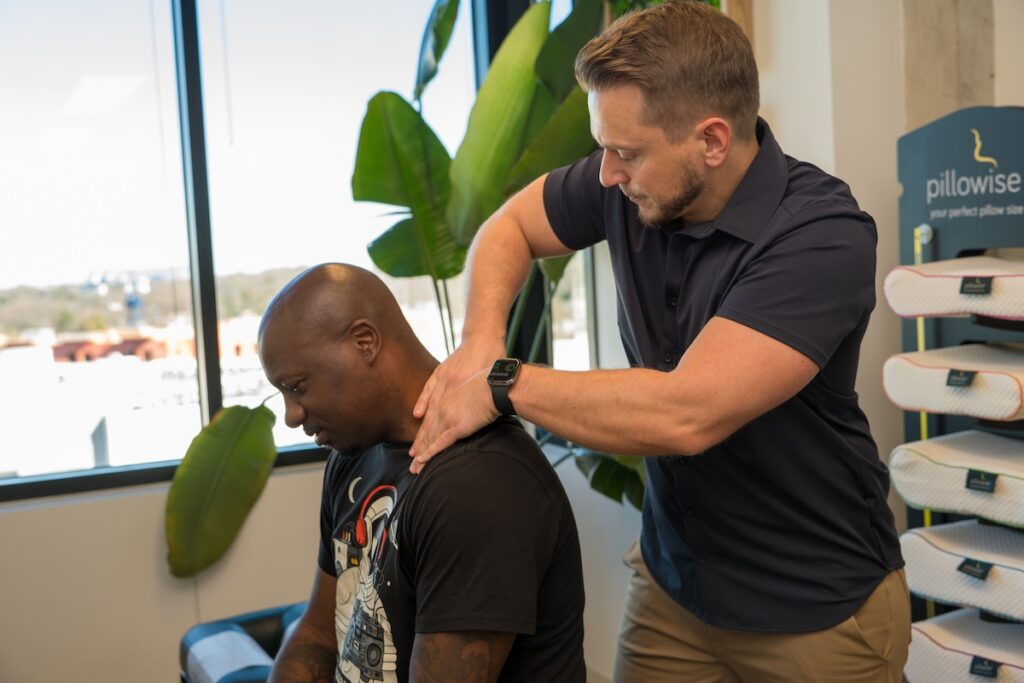
We perform a thorough, hands-on exam and use simple movement screens. If we believe chiropractic care can help, we’ll explain why in plain language and outline a clear plan. That plan may include gentle spinal adjustments, soft-tissue work, mobility drills, and simple stability exercises you can do at home. We pace care to your comfort and align with your training schedule whenever possible.
We track progress, check in often, and adjust the plan as you improve. And if we see signs that you’d benefit from medical evaluation, imaging, or another specialist—like your primary care doctor, a physical therapist, or a sports medicine provider—we’ll let you know and help with a referral. Your safety and autonomy come first.
Practical Ways to Support Recovery at Home
These simple strategies often make training feel better—and they’re safe to try for most people.
- Micro-mobility breaks: Every hour of desk time, take 60 seconds for gentle neck turns, mid-back rotations, and hip openers. Small, frequent motion feeds recovery.
- Warm-down with intent: After runs or lifts, spend 5 minutes on easy nasal breathing while you do light mobility to help your nervous system switch from “go” to “recover.”
- Train the ribcage: 3–4 slow breaths with hands around the lower ribs. Let the ribs expand sideways, then exhale fully. This can improve rotation and shoulder comfort.
- Posture resets: Sit tall on your sit-bones, soften the shoulders, and gently lengthen the back of your neck. Repeat a few times a day—especially before you train.
- Sleep basics: Aim for a consistent sleep window. Use a pillow that keeps your neck in line with your spine—too high or too flat can keep muscles guarding.
- Load management: Nudge volume up by 5–10% per week. If soreness lingers beyond 48–72 hours, pull back slightly and add an extra easy day.
- Active recovery: Easy walks on the greenway, light cycling, or mobility circuits can boost circulation without adding stress.
- Feet first: For runners and lifters, a quick foot-and-ankle warm-up (arches, calves, gentle ankle circles) can improve mechanics up the chain.
When to See a Chiropractor for Recovery Plateaus
If you’ve dialed in sleep, nutrition, and training volume but still feel stuck for 2–3 weeks, a movement-focused evaluation can help. Consider scheduling if you notice recurring tightness on one side, a lift that always irritates the same spot, frequent post-run stiffness that outlasts the warm-up, or a subtle loss of range of motion that your normal stretching doesn’t fix.
Chiropractic care may be appropriate when symptoms seem driven by motion or position—like discomfort that changes with bending, twisting, sitting, or specific lifts. Care is also helpful when you can train, but something always feels “off,” and you’re working around it more each week.
Safety and Red Flags: When to Seek Medical Care Now
Most training aches are not emergencies. Still, certain signs deserve prompt medical evaluation. Please seek urgent or emergency care if you notice any of the following:
- New or worsening numbness, weakness, or loss of coordination in a limb
- Changes in bowel or bladder control
- Fever, unexplained weight loss, or night pain that doesn’t ease with position changes
- Severe pain after a fall, crash, or high-impact event
- Chest pain, shortness of breath, or symptoms that feel systemic rather than musculoskeletal
Myths and Facts About Spine Care and Athletic Recovery
- Myth: If I’m strong, my spine can’t be part of the problem. Fact: Strength helps, but even strong athletes can develop stiff or overloaded segments. Improving how you move often makes your strength work pay off more.
- Myth: Chiropractic is only for people with severe back pain. Fact: Many active adults use chiropractic as part of a conservative plan to move better, manage minor aches, and support training—not just for acute pain.
- Myth: If I stretch more, recovery will fix itself. Fact: Stretching can feel good, but if motion is limited by joint mechanics or motor control, targeted care plus smart mobility works better than stretching alone.
- Myth: An adjustment fixes everything immediately. Fact: Some people feel quick relief, others need a short series of visits plus home strategies. Sustainable change comes from combining care with good training habits.
A Calm, Local Closing
If you’re training hard around Charlotte and not getting the recovery you expect, you’re not failing—your body is asking for a clearer plan. At Feel Good Chiropractic, we take a thoughtful, step-by-step approach to help you move with less resistance and more confidence. Whether you run the rail trail, lift at your neighborhood gym, or chase your kids at the park, we’re here to support your goals in a calm, conservative way.
FAQs
Can spinal adjustments improve muscle recovery?
They may help by improving joint motion and reducing protective muscle guarding. Many people notice easier movement and less post-training tightness. Results vary, and adjustments work best alongside good sleep, nutrition, and smart programming.
How often should athletes see a chiropractor?
It depends on your goals, training cycle, and how your body responds. Some need a short, focused plan; others prefer occasional tune-ups during heavy training blocks. We individualize frequency based on your progress.
Is chiropractic safe during marathon or race training?
For most healthy adults, chiropractic care is considered safe when delivered by a licensed provider. We tailor techniques to your comfort, coordinate with your training, and refer out if anything suggests a medical issue.
Do I need X-rays before starting care?
Not usually. We use imaging only when your history or exam suggests it’s necessary. Most movement-related issues can be evaluated safely without routine X-rays.
What if I’m already working with a coach or physical therapist?
Great. We’re happy to coordinate. Many athletes do best with a team approach that blends coaching, strength, mobility, and manual care as needed.
Can chiropractic help with shoulder or knee aches related to lifting or running?
Sometimes. Because the spine and ribcage influence shoulder and hip mechanics, improving motion there may reduce stress on those joints. If your issue looks primarily local to the shoulder or knee, we’ll address that pattern or refer appropriately.
TL;DR
- Training hard but not recovering often points to inefficiencies in how you move, especially through the spine and ribcage.
- Stiff or irritated spinal segments can keep muscles guarding, reduce efficiency, and make soreness linger.
- Conservative chiropractic care may help restore motion and support smoother recovery, especially when combined with good training habits.
- Try simple at-home resets: micro-mobility, breath work, posture breaks, and smart load progressions.
- Seek medical care promptly for red flags like new weakness, changes in bowel/bladder control, fever, or significant trauma.


